Following the death of Joshua in Judges 2:8, a new generation of Israelites, not knowing the LORD, began serving the Baals (2:11). In 2:13, a consort of Baal, Ashtaroth is mentioned. Though the name has no gender, Ashtaroth appears to be a goddess in the Canaanite religion, possibly associated with the goddess Asherah. Whenever the Israelites would go up to fight, the God of Israel would thwart them because of their idolatry. When they would cry out to the Lord, God would raise up a judge to save Israel. Afterwards, the people would return to their idolatry and the cycle would continue. The word zônâ , ekporneoō in LXX) appears in Judges 2:17 again in association with worship of Baal and the Ashtaroths.
Baal is next mentioned in Judges 6:25 where Gideon is instructed to destroy his father’s altar to Baal and the Asherah tree associated with it. God then told him to use the wood from the Asherah to build a proper altar and sacrifice a bull to the God of Israel. When the people of the town found out what Gideon had done, they called on him to be killed. However, his father, Joash, defended him saying if Baal is a real god, then he can defend himself.
Gideon would go on to defeat Midian and in Judges 8 after the people called upon him and his sons to “rule over them” he rejected this offer and called upon the people to give him the gold earrings from their spoil, which they did. Gideon collected the earrings worth 18,700 grams of gold along with the ornaments worn by the kings of Midian destroyed in the battle. Gideon made an ephod with the gold and ornaments for the altar at Ophrah dedicated to the LORD (Judges 6:24). Unfortunately, the people turned the altar into a place of cultic prostitution (Judges 8:27, zônâ “illicit sexual intercourse,” in LXX, ekporneuō).
In Judges 8:29f, the Israelites joined in with the worship of “the Baal of the Covenant” (baʽal berît) following Gideon’s death. This place was originally commemorated as the place where Abraham had met with the LORD at Shechem. How sad that now at the place of God’s meeting with Abraham at Shechem, the people turned so quickly to idols. The passage claims they had “prostituted” (zônâ, in LXX ekporneuō) themselves with Baal. It appears that they were literally involved in sexual conduct as part of thelr worship. Worship of baʽal berît continued in Judges 9. Abimelech, the son of Gideon (Jerub-Baal) took money from the temple of baʽal berît and used it to hire followers who would help him, along with the citizens of Shechem, murder Gideon’s other 70 sons, and make him king for three years.
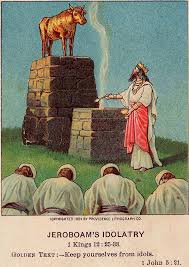
Under Jeroboam, following the division of Solomon’s kingdom into the northern state of Israel and the southern state of Judah, loyal to the line of David, the Israelites set up two idols in the form of calves at Dan and Bethel (1 Kings 12:25-30). In 1 Kings 16:23f, Omri became king of Israel. He forsook the Lord and followed unnamed idols. His son, Ahab became king (16:29), and married Jezebel of the Sidonians. Apparently, at her urging he began to worship Baal and even set up a temple to Baal in Samaria, the capital of Israel. He also fashioned an Asherah tree.
Against the backdrop of detestable Baal Worship, Elijah the Tishbite went to Ahab and told him that there would be no rain in the land for the next three years until he, Elijah, gives the word (17:1). Of course, this was to show Ahab that Baal, the storm and fertility god, had no power in Israel. There is irony that he went to the land of Sidon, Jezebel’s home country, where he ended up helping a Sidonian widow and her son. She gave him bread though she only had enough flour and oil for herself and her son. Elijah promised that the flour and oil would miraculously remain until the rains returned.
In chapter 18, in the third year of no rain, the LORD tells Elijah to return and present himself to Ahab, and He will cause it to rain. It is at this time that Elijah challenges the 450 prophets of Baal and 400 prophets of Asherah at Mount Carmel to show the people that the LORD is real and Baal is not. Both Elijah on the one hand, and the prophets of Baal and Asherah on the other hand build rival altars for sacrifice and call upon their gods to appear. However, Baal did not answer the prophets of Baal, and the LORD did answer Elijah. The people proclaimed the LORD is the true God, and Elijah had all the prophets of Baal killed. Then the rains returned. When Jezebel threatened to kill him, Elijah ran away to Beersheba in the south where God promised that there were 7,000 in Israel that had not “bowed the knee to Baal, nor had kissed him (19:18).”
There is a strong parallel between Elijah, the champion for Yahweh against Baal, and Moses, champion of Yahweh against his people’s continual descent into idolatry. In Exodus 33:12-23 God, in the midst of a conversation about His threat to destroy obstinate (“stiff-necked” עם־קְשֵׁה־עֹ֔רֶף ) Israel, permitted Moses to see a glimpse of the back of his kabôd (glory כָּבוֹד “splendor, magnificence, mark of honor, manifestation of power”) when His glory “passes by” (cobēr עָבַר ). In 1 Kings 19:11, following Elijah’s victory over the prophets of Baal and Asherah in chapter 18, God, near to the same Mount Sinai (Horeb) where Moses had talked with God, told Elijah that his presence would “pass by” (cobēr) him. Unlike with Moses, God spoke to Elijah, not in the wind and fire, a clear rebuke of the storm god Baal, but in “a gentile whisper.” Elijah is the new Moses and like him, he will go to be with the Lord in mysterious circumstances. Just as the people feared God and took off their ornaments (עֶדְיָ֖ם apparently having associations with idolatry, Colossians 3:5-6) in response to Moses’ dialogue with God, the people did turn back to God following Elijah’s defeat of Baal on Mount Carmel.7
Other parallels between Sinai and Carmel are very strong. On Mount Carmel the events form a pattern of covenant making, a renewal of the covenant with Moses at Sinai. Just as Moses built an altar with twelve stones to symbolize the twelve tribes of Israel (Exodus 24:4), so did Joshua set up twelve stones at Gilgal in covenant renewal (Joshua 4:3), and Elijah built an altar of twelve stones for the twelve tribes on Mount Carmel (1 Kings 18:31). In the covenant renewal on Mount Carmel, Elijah asks the people how long they will straddle two positions: If the LORD is God, choose Him, if Baal, choose him. Of course, this ended with the people proclaiming the Lord as God and Elijah commanding that the prophets of Baal be killed. A similar event took place at Sinai following the debacle with the golden calf when Moses had the Levites kill all those devoted to the calf.8
Following the death of Ahab, 1 Kings ends with the rise of Ahaziah, Ahab’s son, to reign as king. 1 Kings 22:53 says that Ahaziah worshiped Baal like his father. 2 Kings 1 opens with Ahaziah injuring himself and calling on Baal-Zebub, god of Ekron, to see if he will recover. Elijah said, “Is it because there is no God in Israel” that Ahaziah calls on a foreign
god? He then prophesies that Ahaziah would not rise from his bed and will die. Joram, another son of Ahab, succeeds Ahaziah. Apparently, Ahab had made a sacred stone (“pillar,” “stele, monument, in LXX, stēlē” מַצֵּבָה cf., Leviticus 1:26) as an object of Baal worship. Even though Joram (Jehoram) did evil like his father Ahab, he had, at least, gotten rid of the sacred stone (2 Kings 3:2).
Later, the sacred stone of Baal returned to the temple of Baal in Samaria. Jehu rose up and killed Joram (2 Kings 9:24) then, he killed all the remaining family of Ahab (chapter 10) and by trickery lured all followers of Baal to the temple of Baal in Samaria (chapter 10). There he slaughtered all of them, burned the sacred stone of Baal, and destroyed the temple of Baal, turning its remains into a latrine.
In 2 Kings 11:18 (cf. 2 Chronicles 23:17) we discover that there was an apparent temple to Baal in Judah as well. The inference is that it was promoted by Athaliah, mother of Ahaziah who had been killed by Jehu of Israel. Following the death of Ahaziah, she immediately killed all the royal family. Only baby Joash was saved and he and his nurse were hidden by Jehoiada the priest of the LORD. After six years, Jehoiada brought Joash out from hiding, had him proclaimed as king and had Athaliah killed. Then in verse 18 we find that the people of the land rose up, destroyed the temple of Baal, smashed its altars and killed Mattan the priest of Baal in front of the altars. We find that Joash ruled Judah and did what was right in the eyes of the LORD except that he did not destroy the high places (bamoth). We know from Numbers 22:41 that the high place was a place signifying the rule of Baal and apparently offerings and worship could be made there. In Judah, the temple of the LORD was near Mount Zion on the only high place allowed for worship.
In 2 Kings 17, at the time of the capture of Samaria by the Assyrians, the text says that the destruction of Israel was the result of the faithlessness of the people for they had “secretly did things against the LORD their God" that were not right. From watchtower to fortified city they built themselves high places in all their towns. They set up sacred stones and Asherah trees on every high hill and under every spreading tree. At every high place they burned incense, as the nations whom the LORD had driven out before them had done (2 Kings 17:9-11 NIV). They also had worshiped Baal, set up an Asherah tree, and bowed down to the starry host ( לְכָל־צְבָ֣א הַשָּׁמַ֔יִם “belonging to all the armies of the heavens”). Worshiping “the sun, moon, or the starry host” was forbidden in Deuteronomy 17:3 and individuals who do such things were to be stoned to death at the testimony of 2 or 3 witnesses. In verse 4, the text reports that the Israelites had practiced divination (קסם ) and “sacrificed their sons and daughter in the fire.” We know from Jeremiah 19:5 (cf. 7: 31; Deuteronomy 12:31) that this sacrifice of “sons and daughters” was part of Baal worship.
In Judah, Manasseh, son of Hezekiah rebuilt the high places his father had destroyed, erected altars to Baal and an Asherah tree, sacrificed his own son in the fire, practiced divination, sought omens, consulted mediums, and worshiped and bowed down to the starry host. He even put an Asherah tree in the temple of God (2 Kings 21:3-7). These practices would eventually lead to the exile of Judah. Josiah, two kings later, would remove the articles of Baal and the Asherah tree from the temple of the Lord (2 Kings 23:4-7). He burned the Asherah tree in the Kidron Valley and did away with the priests of Baal. He also tore down the quarters for the male cult prostitutes (hakadesh הַ article plus קָדֵשׁ adjective, masculine plural, in LXX kadēsmi) located in the temple of the Lord. The first mention of a homosexual cult prostitute (singular, the word kadesh can also mean “holy” or “dedicated”) associated with high places, Asherah trees and sacred stones is in 1 Kings 14:23-24. This is a further mention of the association of illicit sexual practices with Baal worship. By cleaning out these detestable things in the land, King Josiah bought a reprieve for Judah.
Jeremiah also prophesied against the false prophets who prophesied by Baal (Jeremiah 2:8, 7:9). He claims that the altars to Baal are as many as the streets of Jerusalem (Jeremiah 11:13, 17), and that the people had once sworn by Baal (Jeremiah 12:16). He laments that the people of Judah had built the high places for Baal and burned their children in the fire as offerings to Baal (Jeremiah 19:5) and this has brought warnings of disaster from the Lord (19:3). In Jeremiah 23:13, 27, God warns that the northern kingdom of Israel had also practiced detestable Baal worship and were destroyed and discusses that these lying prophets believed they got their prophesies from dreams. As the Babylonians attack Jerusalem, Jeremiah recounts that the people were burning incense on their roofs to Baal (32:29) and pouring drink offerings to other gods. The people “built high places for Baal in the Valley of Ben Hinnom to sacrifice their sons and daughters to Molek (32:35).”
The name Molek (מֹלֶךְ ) means king, and so the text might be saying the sacrifices were for a king, or most probably Baal. Some other texts where Molek is mentioned with references to child sacrifice are Leviticus 18:21 and 20:2-5. In Leviticus 20 the penalty for this abominable practice is death by stoning. In 1 Kings 11:7, we find that even King Solomon built an altar on a high place to the Moabite god Chemosh and on a high place for Molek associated with the Ammonites. He also built high places for the gods of his many wives. For these practices God promised he would tear ten of the northern tribes from the rule of his son. These high places were later torn down by Josiah as part of his reforms (2 Kings 23:13).
Chemosh is mentioned in Judges 11:24 and alluded to in 2 Kings 3:27. Most of our knowledge of this god is from the Mesha stele. The Mesha stele is also famous for having a second reference to the “house of David” outside the Bible. The first reference is the Tel-Dan stele.9 From the Mesha stele, we learn that a high place was dedicated to Chemosh of Kerioth, and that there was a “fire hearth” before an image of the god. Perhaps this is the place of child sacrifice. One reference in the stele to the god was a combination of Chemosh and a female goddess, Ashtarte. Some scholars see this as an absorption of the female deity, Ashtarte, into the male. Also, Chemosh has a similar role as the LORD in 2 Kings, so perhaps semitic deities were seen as operating similarly10
In Hosea 2:8, Baal is associated with silver and gold used in worship, and Hosea 13:1 has an innocuous mention of Baal worship. This should be compared with the use of ornaments associated with idolatry in Exodus 33:6, a symbol of inordinate wealth and greed (Colossians 3:5). Finally, mention is made in Zephaniah 1:4-5 of Baal worship, and priests’ worship of the starry host from the roof-tops and their divided loyalty between the LORD and Molek (which, as already mentioned, could be another way of referring to Baal).