Why We Believe
9. Christ in the Old Testament (Part 3)
9. Christ in the Old Testament (Part 3)
“…He witnessed to them from morning till evening, explaining about the kingdom of God, and from the Law of Moses and from the Prophets he tried to persuade them about Jesus. (Act 28:23b NIV)
Isaiah
Isaiah was written/compiled by Isaiah ben Amoz in the eighth century before Christ. The unity of the prophecy has been debated in scholarly circles for over 200 years. Some scholars claim Isaiah ben Amoz wrote only the first 44 chapters and someone else wrote 45-66. Some scholars even divide up Second-Isaiah. Reasons include alleged literary differences between the two parts. Also, the name Cyrus appears in the last verse of 44 and the first verse of 45 even though Cyrus became king of Persia in the Fifth century BC. The name could have been a gloss incorporated into the text originally as a note by a scribe13 or it could have been original. Arguing against disunity is the fact that no early example of a divided prophecy of Isaiah exists. We know that Isaiah has been a unity since the end of the Second century BC because an intact Isaiah scroll dated 100 BC was found as part of the Dead Sea Scrolls at Qumran. It is also intact in the Septuagint, the Greek translation of the Old Testament. Also, there is no mention of places other than Judah and Jerusalem to suggest that other than Palestine was the country of origin of the prophecy. Finally, there is a close similitude between the prophesy of Chapters 40-66 to that of Isaiah’s contemporary, Micah,14 placing the entire book back in the eighth century.
Isaiah 7:14
It is clear that according to the New Testament, Mary, the mother of Jesus of Nazareth, was a virgin when she conceived Jesus. Luke 1:27-34 first announces that a virgin (parthenos) will give birth to a son, and Mary asks how this can even be possible. Matthew in 1:24 even quotes Isaiah 7:14 using the Greek word for virgin parthenos. The controversy comes with the word translated “virgin” (calmah) in Isaiah 7:14 because in the Hebrew language calmah can also mean “young woman.” Jewish and secular commentators will claim that the word is not virgin, but young woman and the “prophesy” is not a prophesy of Messiah but is instead about a young woman that was a contemporary of Isaiah.
Michael A. Rydelnik in his “The Virgin Birth in Prophesy” makes a compelling case that Isaiah 7:14 is a prophecy of Jesus Christ and that calmah is correctly translated “virgin.”15 First of all, calmah in all instances used in the Old Testament is either neutral or virgin in meaning. Although it could be translated as “young woman” it is never clearly only “young woman.” Second, the use of parthenos is always “virgin” in the Greek so the Septuagint translators of the Hebrew and the New Testament writers clearly understood the Hebrew meaning to be “virgin.” Third, in the context Ahaz was not given the specific sign of a virgin conception as the use of the Hebrew pronoun translated “you” is plural, a change from the singular use in verses 4 and 11.16 The sign here was given to the nation. Fourth, his name is called Immanuel in verse 14 which is a divine title (cf. In Isaiah 8:8 Judah is Immanuel’s land; also 9:6 is clearly a continuation commentary on the son who will be on David’s throne). Fifth, the Hebrew shows a switch back to the present situation in verse 16 in which God gives the reluctant Ahaz, who refused a sign, a different sign that Isaiah’s son Shear-Jasub (verse 3) would soon see the destruction of Aram and Ephraim. The fulfillment of the short-term prophesy will be assurance that the long-term prophecy of the Messiah would also be fulfilled.
Isaiah 52:13 – 53:12
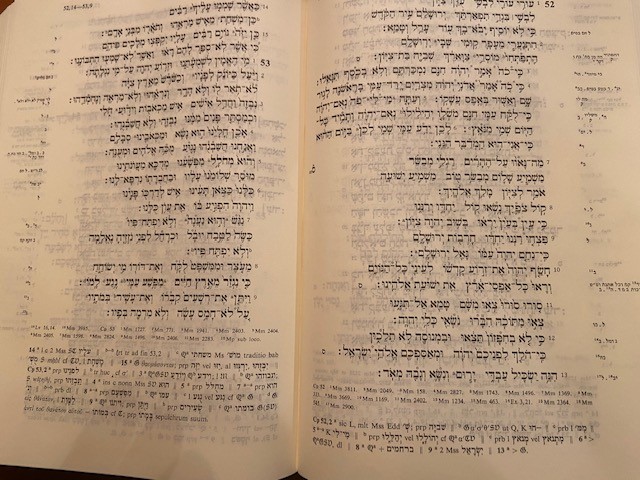
Jewish apologists have long identified the Suffering Servant of Isaiah 52:13 - 53:12 with the nation of Israel17 claiming that this portion of Isaiah could not possibly be identified with Jesus of Nazareth. However, in Isaiah 6:1 and 57:6 the phrase “high and lifted” (rām wěniśoʾ) is clearly used to describe the Lord God “In the year that King Uzziah died I saw the Lord sitting upon a throne, high and lifted up (Isa 6:1 ESV). It is also used to describe the suffering Servant in 5:13. It is clear that this Suffering Servant discussed here and throughout chapter 53 in context is a divine figure and not Israel as the rabbis assert!
Just who is this Suffering Servant? In 52:14 we find that his appearance was disfigured18 eerily descriptive of what Jesus would look like after being beaten and whipped and hanging on a cross for several hours. Isaiah 53:2-4 continues to describe the scene of the Suffering Servant. We learn that he was being punished by God for the sins of the people. In verse 5 the Servant again is described as the “pierced”19 one who is punished for the people’s transgressions. His punishment is vicarious (punished in place of another)—His “stripes”20 bring peace and healing. The stripes would correspond to Jesus’ scourging (Matthew 27:26; Mark 15:15; John 19:1) from the Roman soldiers and the piercing (John 19:34 “spear in his side”) while Jesus was on the cross.
Verses 7-10 continue the remarkable description of the events leading to Jesus’ death. First, he was oppressed21 and led away, but did not open his mouth to make a defense of himself. This scripture was fulfilled when Jesus was before Pontius Pilate (Matthew 27:14; Mark 15:3). Again, it is reiterated that this suffering Servant would be punished vicariously for the people. In verse 9, the suffering Servant would be buried in a rich man’s grave (cf. Matthew 27:57-30; Mark 15:43-46; Luke 23:50-53; John 19:38-42). The passage in verse 11 reiterates that the death of this Suffering Servant will be a vicarious death.
Finally, in verses 11-12, this Suffering Servant, who himself is Righteous, through his death will make others righteous (justify others).22 In verse 12, not only does this righteous, suffering Servant offer a vicarious death, He will be rewarded after death a position among the great (Matthew 26:64; Mark 14:62; 16:19; Acts 2:33; Hebrews 10:12; 12:2; 1 Peter 3:22) and He will act as intercessor for sinners (Hebrews 7:25; 1 Timothy 2:8). What a remarkable prophecy of Jesus some 750 years earlier!
Micah
Micah 5:2-5a
Micah, an Eighth century BC contemporary of Isaiah, was an observer of the dismantling of Israel and attack on Judah by Assyria. It is certainly not lost on Matthew that there is a link between Isaiah’s prophecy of the birth of a son from a virgin (Isaiah 7:14) and the birth of the son in Micah 5:3. The location and circumstance of this birth is clearly messianic. This prophesy of a coming ruler stands as an important parenthesis in the current horror of the Assyrian invasion. God wishes to give His people a hope for the future even though the present remains bleak. In verse 2 the full location name is given23 as there is another Bethlehem in Zebulon (Joshua 19:15) The distinction is important because the Messiah is to come from Judah and here narrowed to Bethlehem, the house of Jesse and David the first king of the Messianic line.