In Exodus 20, God presents to Israel through Moses His famous ten commandments. First, God identifies himself as the LORD God(יְהוָ֣ה אֱלֹהֶ֑֔יךָ ) who had delivered them from “a house of slavery” (מִבֵּ֣֥ית עֲבָדִֽ֑ים ) in Egypt. The first four of the commandments are about our relationship with God, and the last six are about our relationships with others. These are mirrored, of course, in Jesus’ famous answer to the expert on the law in Matthew 22:37-40 and Luke 10:27, in which He was asked what was the greatest commandment in the Law. Jesus answered quoting Deuteronomy 6:5 and Leviticus 19:18 as a summary of Moses’ ten commandments. The first two commandments deal explicitly with idolatry with the second commandment elaborating on the topic.
In the second commandment elaboration (make no image of other gods in the form of the God of heaven or anything on earth) is an explicit statement that failure to follow will bring punishment of the sin of the parents up to the fourth generation, an example of generational lines of sin. Other scriptures make it clearer on what an image is: Deuteronomy 4 identifies an idol as the shape of a man or woman, any animal on earth, in the sea or flying in the air, and the sun, moon and stars. So, an idol is an object of worship that comes in place of God. In verse 29 there is a promise to those that get ensnared in idolatry and the punishments that follows if they seek (בקשׁ “ look for, try to obtain, pray/plead to be near”) God with all the heart (innermost being, mind).
It is interesting that in the elaboration on what an image is in Deuteronomy 4, the first two examples are images of men and women. Considering that there is so much of a link between idolatry and sexual immorality (Colossians 3:5-6) it would appear that this may be what is in mind here. In Deuteronomy 4:16, an image is something you would look at (LXX homoiōma “likeness, copy, appearance”). Putting that with the list in Colossians 3, idolatry, at the very least, is something that one looks at to stimulate to sexual immorality (porneia) which is at the top of the Colossians 3 list (cf., Ezekiel 23:37). Archeologists have found many big-breasted female images in digs throughout Israel even within sight of the Temple Mount.1 Porneia is often translated as fornication or prostitution. Ezekiel 43 also describes in a vision, prostitution associated with idolatry at the Temple of God.
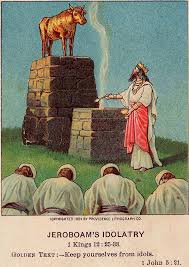
The first instance of idolatry in Israel’s history is the worship of the golden calf in Exodus 32. The scene opens with the people anxious and impatient from the long absence of Moses, who has been meeting with God and getting the Law on Mount Sinai. They asked Aaron to make gods for them for they did not know what had become of Moses. So, Aaron quickly acquiesced! They took of their gold earrings, melted them down and with an engraving tool, fashioned them into the image of a calf. Aaron had them build an altar to offer sacrifices, and then sacrifices and a festival was proclaimed for the next day. At the festival, first they sat eating and drinking then stood up for revelry. The word for “revelry” is צחק and can be translated as “amuse oneself and fondle women.” So, it is clear that there was a high degree of sexual immorality as part of the festival. This was such a traumatic moment in Israel’s history that it is mentioned again in Deuteronomy 9:7f and Nehemiah 9:18 as a warning.
Later, after entering the land of the Canaanites, the Israelites did not follow through in destroying all the people, so Israel ended up coming under Canaanite influence and began adopting their idols. Chief among the idols adopted from the Canaanites was Baal (בַּ֫עַל ). The name Baal literally means “master” or “lord.”
In Canaanite mythology, Baal was understood as the “son of Dagon” (another god adopted by the Philistines); however, this relationship is probably understood as “one associated with” as he is more commonly known as the son of El.2 Baal is also referred to as “Hadad” the storm god responsible for rain and crops for harvest.3 We know much about this Canaanite god through Ugaritic texts from the second millennium BCE. In these texts, Baal is placed under “El” (אֵל ) the god probably known to Abraham when he appeared on the scene in the early second millennium BCE. Abraham would qualify his knowledge of this god and use this name for “the LORD God most high” ( אֶל־יְהוָה֙ אֵ֣ל עֶלְי֔וֹן Genesis14:22) or just “God most high” ( אֵ֣ל עֶלְי֔וֹן Genesis 14:20)4. From the text in Genesis 14:20 we also find that “the LORD God most high” is associated with Melchizedek, king of Salem (later Jerusalem). In Numbers 24:16, “the most high” is identified with El and the Almighty (cf., also Genesis 17:1), all one and the same. The phrase “most high” also appears as an alternate name for YHWH in many of the Psalms (7:17; 21:7; 47:2).
“The LORD God most high” and Baal co-existed in conquered Canaan among Israel, though with the giving of the ten commandments this syncretic tendency was not ever really approved, just tolerated. This toleration is evident even up to the beginning of the monarchy under Saul, David and Solomon. However, underlying this tolerance was a simmering rivalry that, perhaps, came to a head when the sexual excesses of Baal worship among the people could not be ignored.
Baal was often associated with various localities such as Peor (Baal-Peor Deuteronomy 4:3, Numbers 25:3), Perazim (Baal -Perazim 2 Samuel 5:20, 1 Chronicles 14:11), Hazor (Baal-Hazor 2 Samuel 13:23, Gad (Baal-Gad Joshua 13:5), Zephon (Baal -Zephon Exodus 14:2, Numbers 33:7), Hermon (Baal-Hermon 1 Chronicles 5:23), Hamon (Baal-Hamon Song of Songs 8:11), Shalishah (Baal -Shalishah 2 Kings 4:42). Many of these places associated with Baal are mentioned throughout the campaign of Joshua in the book bearing his name. This reveals the extensive hold Baal worship had in the land of Canaan and explains why God was so intent that these people be destroyed so they would not be a snare for Israel.
Finally, there is Baal-Zebub (2 Kings 1), the god of Ekron, which became synonymous with the “prince of demons” (Satan) in the New Testament (Matthew 12:24) as a result of Jesus’ healing of a demon-possessed man. The name Baal-Zebub consists of two parts, Baal, besides lord and master, can also mean husband or owner (possessor) and "zebub" which means “flies.” It is associated with the root which means “to go hither and thither,” So, Baal-Zebub means Lord of the Flies. Flies do not follow any authority so the name is an empty title. Taking a moment and looking at the behavior of flies may help us to understand what evil really is and how it works.
“God's empire is like that of bees. The Hebrew word for bee, ( דְּבוֹרָה ) deborah is the feminine version of the masculine ( דּבר ) debar, “Word” (logos in Greek, cf., John 1:1). Bees have a house, like flowers, make honey, speak a language, care for offspring, [and] are armed. Satan's 'empire' is like flies. Flies are homeless, like dung and decaying flesh, make nothing, speak no language, don't care for their offspring, [and] are not armed.” (Unknown source)
The origin of Baal as Lord of agriculture and fertility is discussed in texts discovered at Ugarit in northern Syria. Baal was challenged by Mot, god of the underworld, who temporarily triumphed and Baal disappeared to the underworld. He was later brought back to life after Anat and Shapash, the sun god, found him. This theme of the “death” of Baal corresponds to the end of the rainy season and the panicked need to bring him back to life corresponds to the return of the rainy season in the spring. Rain must come at just the right time for the crops to succeed. Human fertility and the need to keep the population stable also portends along with the fertility of the soil, and this explains the sexual nature of Baal worship.5
The first mention of Baal is in Numbers 22:41 in association with a high place bamoth, LXX stēlē or stela, “block or slab with an inscription.” The bema seat was mentioned in the New Testament as a place of judgment of Christians (2 Corinthians 5:10) and was also associated with earthly rulers such as Herod and Pilate, who would pronounce judgments from a “high place” or balcony above the people at court. The Old Testament bema, or high place, was probably wooded and where one can seemingly get closer to God or the gods. Why God or gods? In popular Israelite worship at these sites, an asherah tree or pole (symbol of fertility, perhaps phallic) represents the goddess Asherah, an image of worship mentioned in Ugarit literature as the consort of El, the mother of the gods. Asherah was seen as a consort for El, Baal (consort Anat in Canaanite religion) or the LORD by many in Israel.
A reason for these high places as unofficial places of worship was probably based in stories of visitation by a deity to a particular place in Canaanite religion. For Israel, a reminiscence of the Abrahamic visit to the “oak of instruction” (an elon môreh, a cultic tree, Genesis 12:6) at Shechem, or Jacob’s erection of a stone to a vision of the LORD at Bethel (Genesis 35:15) could provoke popular worship.6 An example of this confusion in popular religion is an inscription from the eighth century BCE found at a shrine at Kuntillet Ajrud in the Sinai desert. Amid a scene on a plastered wall of a bare-breasted female figure seated on a lion throne is the Hebrew inscription “I bless you by YHWH of Samaria and by His Asherah.” However, we know from Scripture that YHWH doesn’t have a goddess consort. Asherah is the consort of El in Canaanite religion!
Baal is mentioned again in Numbers 25:3 in association with the city of Peor. The context, beginning in verse 1 is that the Israelites were enticed by Moabite women into sexual immorality (zônâ זָנָה, ekporneoō in LXX) as part of worship (offering sacrifice) to other gods identified as Baal of Peor. In response, God sent a plague on Israel resulting in the deaths of 24,000 people. The plague stopped when Phineas, son of Eleazar followed an Israelite man taking a Midianite woman into a tent and thrust them both through with a spear. Presumably, the man was on top of the woman engaging in sexual intercourse with her. In fact, a definition of zônâ is “illicit sexual intercourse.” In Deuteronomy 4:1-4, as part of a long discourse by Moses to the people of Israel, Israel was reminded of this incident at Baal Peor (cf., Psalm 106:28).
Page 2